
Amblyopia, commonly called lazy eye, is reduced vision in one or both eyes that develops during childhood. It happens when the brain does not learn to use the vision from an eye normally while a child’s visual system is developing.
Amblyopia is one of the most common vision problems in children, but it can also be one of the easiest for parents to miss. A child may have significant amblyopia even when both eyes look completely normal. When one eye sees well, children often simply rely on that stronger eye and may never complain that something is wrong.
The good news is that amblyopia is treatable, especially when identified early. Treatment may include glasses or contact lenses, eye patching, atropine eye drops or newer digital amblyopia treatments. When another eye condition is interfering with vision, that condition may need treatment as well.
Pediatric Amblyopia Specialists in Metro Detroit
Children’s Eye Care has specialized in children’s eye care in Metro Detroit since 1973. Our pediatric ophthalmologists and orthoptists diagnose and treat amblyopia every day—from children referred after a failed vision screening to those with amblyopia related to significant refractive errors, strabismus, congenital cataracts, ptosis and other complex pediatric eye conditions.
Amblyopia care often requires more than making a diagnosis at one visit. Children’s vision changes as they grow, and successful treatment depends on carefully measuring each eye over time and adjusting treatment as vision develops.
At Children’s Eye Care, our pediatric ophthalmologists work closely with orthoptists who specialize in evaluating children’s vision, eye alignment, eye movements and binocular vision. This collaborative approach is especially valuable when caring for babies, toddlers and young children who cannot simply read a traditional eye chart and tell us what they see.
What Is Amblyopia?
Children are not born with fully developed vision. During infancy and childhood, the brain learns how to interpret and use the images it receives from each eye.
For vision to develop normally, the brain needs a sufficiently clear image from each eye. If one eye consistently sends a poorer image—or the brain has difficulty using the images from the two eyes together—the brain may begin favoring the stronger eye.
Over time, the visual pathway involving the weaker eye may not develop normally. This is amblyopia.
That also explains why putting the correct glasses on a child doesn’t always immediately give the weaker eye normal vision. Glasses can provide a clearer image, but the brain may still need time and treatment to learn to use that eye more effectively.
If amblyopia is not identified and treated during childhood, reduced vision can persist into adulthood.
What Causes Amblyopia (Lazy Eye) in Children?
There isn’t one single cause of amblyopia. Anything that significantly interferes with normal vision development can potentially lead to it.
Refractive Amblyopia
A refractive error occurs when the eye does not properly focus light without optical correction. Significant farsightedness (hyperopia), nearsightedness (myopia) or astigmatism can interfere with normal vision development.
Sometimes both eyes are affected.
In other children, one eye needs a much stronger glasses prescription than the other. This difference between the eyes is called anisometropia. The brain receives a clearer image from one eye and a blurrier image from the other and may increasingly rely on the clearer eye.
This can be particularly difficult for parents to recognize because the child’s eyes may look perfectly normal.
Related: Refractive Errors in Children
Strabismic Amblyopia
Strabismus occurs when the eyes are not properly aligned. One eye may turn inward, outward, upward or downward.
When one eye is frequently misaligned, the brain may begin suppressing or ignoring its image. If this happens while vision is developing, the misaligned eye may develop amblyopia.
Strabismus and amblyopia are related, but they are not the same condition. A child can have strabismus without amblyopia, amblyopia without strabismus, or both.
Related: Strabismus (Crossed or Misaligned Eyes)
Deprivation Amblyopia
Deprivation amblyopia occurs when something physically prevents a clear image from reaching the eye during visual development.
Potential causes include a pediatric cataract, significant ptosis (droopy eyelid) or another abnormality that obstructs or significantly blurs vision.
This form of amblyopia can be particularly serious when it develops during infancy because visual development is occurring rapidly. The underlying eye condition may need prompt treatment to give vision the best opportunity to develop.
Related: Pediatric Cataracts | Pediatric Ptosis
Combined Amblyopia
Some children have more than one factor affecting their vision. For example, a child may have both strabismus and a significant difference in prescription between the eyes.
Determining why a child’s vision has not developed normally is an important part of creating the right treatment plan.
What Are the Signs and Symptoms of Amblyopia?
Perhaps the most important thing for parents to know about amblyopia is:
A child with amblyopia may have no obvious symptoms.
Children don’t have another visual experience to compare with their own. If one eye has always been blurry, a young child may assume that’s simply how everyone sees.
And if the other eye sees well, the child may run, play, read and function remarkably well using the stronger eye.
When signs are present, parents may notice:
- One eye crossing, drifting or wandering
- Squinting or closing one eye
- Difficulty with depth perception
- Difficulty performing familiar activities when one eye is covered
- A failed pediatrician, preschool or school vision screening
For many children, a failed vision screening is the first indication that anything is wrong.
How Do Pediatric Ophthalmologists Diagnose Amblyopia?
Diagnosing amblyopia means determining how well each eye sees independently and, equally importantly, determining why one or both eyes are not seeing as well as expected.
A pediatric eye examination may include:
- Age-appropriate vision testing of each eye
- Eye alignment testing
- Evaluation of eye movements
- Pupil examination
- Measurement of refractive error
- A dilated eye examination
- Evaluation of the retina, optic nerve and other structures of the eye
The exact examination varies based on the child’s age, development and reason for referral.
What If My Child Is Too Young to Read an Eye Chart?
Children do not need to know letters—or even be able to talk—to have their eyes and visual development evaluated.
Pediatric ophthalmologists and orthoptists use different methods to evaluate babies, toddlers, preschoolers and children who cannot reliably complete a traditional adult eye examination.
At Children’s Eye Care, our orthoptists work alongside our pediatric ophthalmologists to evaluate visual acuity, eye alignment, eye movements and binocular vision using age-appropriate testing.
For a child with amblyopia, these measurements aren’t simply part of making the initial diagnosis. They help us determine whether treatment is working and when treatment needs to be changed.
How Is Amblyopia Treated in Children?
Treatment depends on the cause and severity of the amblyopia, the child’s age, previous treatment and how the child’s vision responds over time.
Treatment usually begins by giving the brain the clearest possible image from each eye and addressing whatever is interfering with normal visual development.
Depending on the child, treatment may include:
- Glasses or contact lenses
- Eye patching
- Treatment of an underlying eye condition
- Atropine eye drops
- Other forms of optical treatment
Not every child needs every treatment.
When Glasses Are Part of Amblyopia Treatment
Not every child with amblyopia needs glasses. Amblyopia has several different causes, and treatment is based on what is interfering with normal vision development.
When refractive error—such as farsightedness, nearsightedness, astigmatism or a significant difference in prescription between the two eyes—is contributing to amblyopia, correcting that refractive error is an important part of treatment.
For these children, glasses do more than make things look clearer while they are being worn. Providing the brain with a consistently clearer image gives the visual system a better opportunity to develop. In some children with refractive amblyopia, vision can improve significantly with glasses alone.
Other children may need additional treatment, such as patching or atropine, and children whose amblyopia is caused by strabismus, cataract, ptosis or another eye condition may require a very different treatment plan.
Eye Patching for Amblyopia
When vision remains weaker in one eye, the pediatric ophthalmologist may prescribe patching of the stronger-seeing eye.
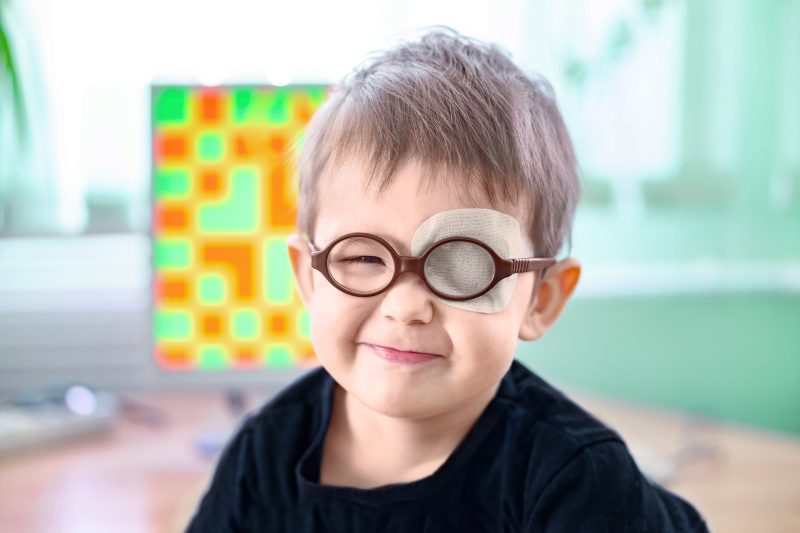
Covering the stronger eye encourages the brain to use the weaker eye and can help that eye’s vision improve.
The amount of patching prescribed varies. More patching is not automatically better. The appropriate schedule depends on factors such as the child’s age, severity of amblyopia and response to treatment.
Parents should follow the prescribed patching schedule rather than increasing or decreasing patching time on their own.
Why Does My Child Have Trouble Seeing When the Patch Goes On?
This can be upsetting for parents—and it’s also one of the reasons some children fight patching.
Remember what we’re asking the child to do: we’re covering the eye they normally rely upon and asking the weaker eye to take over.
A child with significant amblyopia may suddenly struggle with activities that seemed easy a moment earlier because the world really does look blurrier through that weaker eye.
This doesn’t mean parents should abandon patching. It does mean that understanding what the child is experiencing can make the resistance a little less mysterious.
If your child’s vision or behavior while patching concerns you, contact your pediatric ophthalmologist rather than changing treatment yourself.
Having Trouble Getting Your Child to Wear an Eye Patch?
You’re in very good company. Toddlers aren’t particularly famous for enthusiastically accepting medical treatment they didn’t personally request.
Our Patching Help for Parents provides practical advice about choosing patches, preventing peeking, skin irritation, routines, school, rewards and helping children successfully complete treatment.
Related: Patching Help for Parents
Atropine Eye Drops for Amblyopia
At Children’s Eye Care, patching is generally our preferred treatment when a child needs treatment beyond glasses or correction of the underlying cause of amblyopia. However, we also know that successful amblyopia treatment has to be something a child and family can realistically accomplish.
When patching is particularly difficult or a child is unable to wear the patch consistently, atropine eye drops may be an alternative for some children.
Atropine is placed in the stronger-seeing eye and temporarily blurs its near vision, encouraging the brain to rely more on the weaker eye.
Atropine has been well studied as a treatment for amblyopia, but it isn’t appropriate for every child. Our pediatric ophthalmologists consider the child’s vision, glasses prescription, type and severity of amblyopia, age and response to treatment when deciding whether atropine is a good alternative.
Newer Digital Treatments for Amblyopia
Newer digital treatments have expanded the options available for children with amblyopia. These treatments use specialized technology to encourage the brain to use the weaker eye while a child watches video content or participates in a visual activity.
We are pleased that families have more treatment options than ever before. However, patching remains our preferred treatment and the gold standard in our practice for most children who need additional amblyopia treatment. It has decades of clinical experience behind it, is effective for many children, and is also one of the least expensive treatment options available to families.
Digital treatment may be appropriate for selected children, particularly when traditional treatment is difficult to complete. Our pediatric ophthalmologists consider the individual child, the cause and severity of the amblyopia, previous treatment and the family’s experience with treatment when discussing available options.
Does Amblyopia Require Surgery?
There is no surgery that simply “fixes” amblyopia.
However, some children have an underlying eye condition that may require surgery, such as:
- Pediatric cataracts
- Significant ptosis
- Certain forms of strabismus
- Other structural abnormalities affecting vision
Correcting the underlying problem can help provide the eye with a better visual image, but the brain may still need help learning to use that eye.
For this reason, a child may continue to need glasses and/or patching before or after surgery.
How Long Does Amblyopia Treatment Take?
Amblyopia treatment is usually a process rather than a quick fix.
Some children improve relatively quickly. Others require treatment and monitoring over months or longer.
This is one reason regular follow-up with the pediatric ophthalmologist and orthoptist is important. At each stage, we’re evaluating more than whether the child completed the prescribed treatment.
We’re asking:
- Is the weaker eye improving?
- Is the stronger eye maintaining good vision?
- Is the difference between the eyes decreasing?
- Has improvement stopped?
- Does the treatment need to be adjusted?
- Is it time to reduce treatment?
- Does the child still need monitoring?
The answers can change as the child’s vision develops.
Can Amblyopia Come Back After Treatment?
Yes. Amblyopia can recur even after successful treatment.
Research has found that approximately one-quarter of successfully treated children may experience recurrence within the first year after treatment is stopped.
For some children, treatment is gradually reduced rather than stopped suddenly. Continued follow-up allows us to identify a decline in vision and restart or adjust treatment when needed.
Being told that your child’s vision has improved is excellent news, but it doesn’t necessarily mean we’re finished watching it.
Can We Wait Until My Child Is Older to Treat Amblyopia?
Parents sometimes wonder whether it would be easier to wait until their child is older and more cooperative before beginning amblyopia treatment. Unfortunately, waiting can mean losing an important opportunity to improve vision.
Amblyopia develops while a child’s visual system is developing, and there is a limited period during childhood when the brain is most responsive to treatment. In general, the earlier amblyopia is identified and appropriately treated, the better the opportunity for vision to improve.
Some older children and adolescents can still benefit from amblyopia treatment, particularly if they have never been treated. However, amblyopia cannot be reliably corrected at every age, and treatment should not be intentionally delayed with the expectation that it will work just as well later.
We understand that glasses, patching and other treatments can be challenging—especially with a very young child. Our pediatric ophthalmologists and orthoptists work with families to make treatment as manageable as possible while a child’s developing visual system still gives us the best opportunity to improve vision.
If your child has been diagnosed with amblyopia, the time to treat it is when treatment is recommended not when treatment becomes more convenient.
A little boy wearing glasses and an eye patch for amblyopia.
“Lazy eye” is frequently used to describe an eye that crosses or wanders, which creates understandable confusion.
Amblyopia is a problem with vision development. The brain has not learned to use the visual information from one or both eyes normally.
Strabismus is a problem with eye alignment. The eyes do not consistently point in the same direction.
Strabismus can cause amblyopia, but not every child with strabismus has amblyopia. And many children with amblyopia have perfectly straight eyes.
An eye does not have to look “lazy” to have lazy eye.
Related: Strabismus (Crossed or Misaligned Eyes)
Why Early Detection of Amblyopia Matters
Children are remarkably good at adapting.
Unfortunately, that’s one reason amblyopia can remain hidden.
A child with one strong eye may navigate the world very well while the vision in the other eye remains significantly reduced. Amblyopia may not be discovered until a vision screening tests each eye separately.
Vision screening is therefore an important part of childhood care.
A child who fails a vision screening, develops strabismus, has another eye condition that places normal visual development at risk, or has a parent or pediatrician concerned about vision should receive appropriate follow-up.
A failed vision screening doesn’t necessarily mean your child has amblyopia, but it shouldn’t be ignored.
The Unique Role of Orthoptists in Amblyopia Care
Amblyopia treatment depends on something that can be surprisingly difficult: accurately measuring vision in each eye of a child—sometimes before that child can even name a picture on an eye chart.
This is an area where orthoptists have very specialized expertise.
Orthoptists are highly trained eye-care professionals who specialize in visual development, eye alignment, eye movements and binocular vision, with particular expertise in conditions such as amblyopia and strabismus. They are skilled at evaluating vision in babies, toddlers, young children and children whose developmental or communication differences can make traditional vision testing challenging.
At Children’s Eye Care, our orthoptists work side-by-side with our pediatric ophthalmologists. They don’t simply perform a vision test. They understand how a child’s age, attention, development, eye alignment and previous responses can affect testing—and how to use different age-appropriate methods to obtain the most reliable information possible.
Amblyopia Care at Children’s Eye Care
For more than 50 years, Children’s Eye Care has focused on the eye care of children throughout Metro Detroit and Southeast Michigan.
Our pediatric ophthalmologists and orthoptists care for the full spectrum of childhood eye disease—from common conditions such as amblyopia and refractive errors to complex conditions involving strabismus, cataracts, glaucoma, inflammation, the retina and optic nerve.
For children with amblyopia, our goal is not simply to prescribe a patch or make the numbers on an eye chart better.
We want to understand why a child’s vision isn’t developing normally, choose the treatment that makes sense for that child, carefully measure the response and give the developing visual system its best opportunity to achieve strong vision.
Frequently Asked Questions
SCHEDULE AN APPOINTMENT

















Related Posts
More from Children's Eye Care
Hiring Patient Services Representatives & Medical Receptionists
April 29, 2025
John D. Baker, MD Pediatric Ophthalmology Symposium 2027 | Baker Day Detroit
February 4, 2025
Screen Time and Kids’ Eye Health
May 2, 2025

Firework Eye Safety for Children in Michigan | Pediatric Eye Injury Prevention
May 17, 2026
view all articles