
Eyelid Problems in Children: Styes, Chalazia, Blepharitis & More
A red, swollen or crusty eyelid is common in children. Most eyelid problems are not dangerous, but some can be uncomfortable, repeatedly return or—particularly in babies and young children—interfere with normal vision development.
The eyelids do much more than close when we sleep. They protect the eyes, help spread tears across the eye’s surface and contain oil-producing glands that help keep those tears from evaporating too quickly. Blinking also helps clear small particles from the surface of the eye.
When the eyelids or their oil glands become inflamed, blocked or infected, children can develop symptoms ranging from crusty eyelashes to a painful swollen bump.
At Children’s Eye Care, our pediatric ophthalmologists diagnose and treat eyelid conditions in babies, children and adolescents, including chalazia, styes, blepharitis, meibomian gland dysfunction, eyelid infections, eyelid lesions, hemangiomas and other abnormalities affecting the eyelids.
And because children’s vision is still developing, we look beyond the eyelid itself. An eyelid condition that changes the shape of the eye or blocks a child’s vision can sometimes cause astigmatism or amblyopia, making appropriate pediatric evaluation particularly important.
Pediatric Eyelid Specialists in Metro Detroit
Children’s Eye Care has specialized in children’s eye disease in Metro Detroit since 1973.
Our pediatric ophthalmologists routinely evaluate both common and complex eyelid conditions—from a child with recurrent chalazia to an infant with an eyelid abnormality that could interfere with visual development.
One of the advantages of pediatric ophthalmic care is knowing when an eyelid problem is just an eyelid problem and when it isn’t.
A swollen eyelid may be caused by a blocked oil gland, infection, inflammation, allergy, trauma or another condition. A lump that looks like a stye may actually be something different. And a drooping or enlarged eyelid can sometimes obstruct vision enough to cause amblyopia.
Our physicians evaluate the eyelid, eye surface, vision and developing visual system together, rather than treating the visible eyelid problem in isolation.
Common Eyelid Problems in Children
Some of the eyelid conditions we commonly evaluate include:
- Chalazia
- Styes
- Blepharitis
- Meibomian gland dysfunction
- Recurrent eyelid bumps
- Eyelid swelling and inflammation
- Eyelid infections
- Eyelid lesions and cysts
- Eyelid hemangiomas
- Ptosis, or a droopy upper eyelid
Children with ptosis have some additional considerations, particularly when the eyelid interferes with vision.
Related: Pediatric Ptosis (Droopy Eyelid)
What Is a Chalazion?
A chalazion is a bump that forms when one of the tiny oil-producing glands in the eyelid becomes blocked.
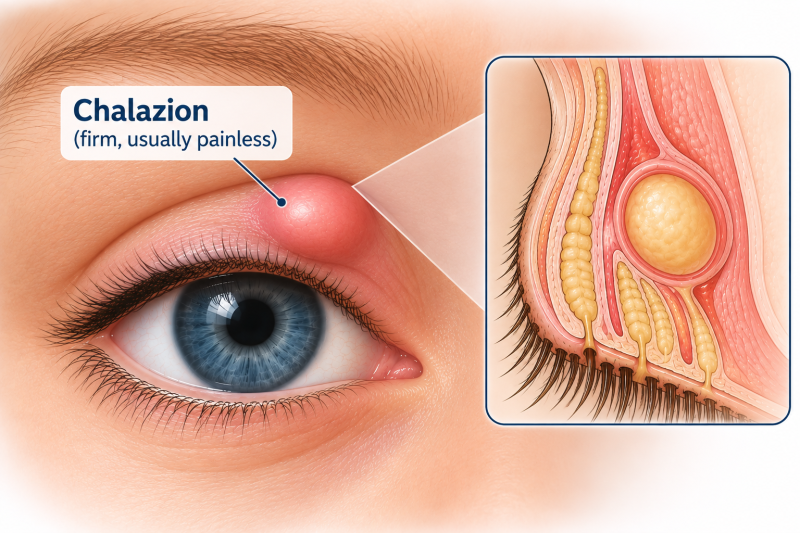
A chalazion is a firm, usually painless bump that develops within the eyelid.
These glands, called meibomian glands, produce oils that are an important part of the tear film covering the eye.
When a gland becomes blocked, oil can back up inside the eyelid and trigger inflammation. The result may be a firm bump in the upper or lower eyelid.
A chalazion can initially become:
- Red
- Swollen
- Tender
- Noticeably enlarged
Over time, it may become less painful while the bump remains.
Children can develop more than one chalazion, and some children are particularly prone to getting them repeatedly.
Is a Chalazion the Same as a Stye?
Not exactly.
Parents understandably use the word stye for almost any bump on an eyelid, but medically there is a difference.
A chalazion develops when an eyelid oil gland becomes blocked and inflamed.
A stye, also called a hordeolum, is an infection involving an eyelid gland and often appears as a more painful, red bump near the eyelid margin.
They can look similar, particularly early on, and inflammation of the eyelids can contribute to both.
The distinction matters because treatment isn’t necessarily identical.
Why Does My Child Keep Getting Chalazia?
Some children get one chalazion and never have another. Others seem to get them over and over.
Recurrent chalazia can be associated with blepharitis or meibomian gland dysfunction, in which inflammation and abnormal oil-gland function make the glands more likely to become blocked. Eye rubbing and certain skin conditions can also contribute.
When a child repeatedly develops eyelid bumps, simply treating each individual bump may not address the underlying eyelid inflammation.
Our pediatric ophthalmologists may therefore recommend an ongoing eyelid-care routine intended to improve gland function and reduce recurrence.
How Are Chalazia Treated in Children?
Many chalazia eventually resolve without surgery.
Initial treatment often focuses on helping the blocked gland drain and reducing eyelid inflammation.
Depending on the child and examination, treatment may include:
- Warm compresses
- Gentle eyelid massage
- Eyelid hygiene
- Prescription medication when appropriate
Warm compresses are generally most helpful when they are actually warm and held against the eyelid long enough to warm the blocked oil.
That can be easier said than done with a two-year-old.
Our team helps families develop an approach that is both medically appropriate and reasonably achievable for their child.
Some chalazia can persist for weeks or even months despite treatment.
Does My Child’s Chalazion Need Antibiotics?
Not necessarily.
A chalazion is primarily caused by a blocked and inflamed oil gland, not simply by an infection. Antibiotics therefore aren’t automatically necessary for every chalazion.
Medication may be appropriate when there is associated infection, significant blepharitis or another clinical reason to use it.
The treatment should be based on what is actually causing the child’s eyelid inflammation rather than assuming every eyelid bump needs an antibiotic.
When Does a Chalazion Need Surgery?
Most chalazia do not require surgery.
However, surgical drainage may be considered when a chalazion becomes very large, persists despite appropriate treatment, repeatedly causes problems or is significantly affecting the eye.
In young children, there is an additional consideration:
A large chalazion can press on the developing eye and temporarily change its shape, producing astigmatism and potentially contributing to amblyopia. AAPOS specifically notes that large persistent chalazia can cause eye problems in young children.
When surgical drainage is necessary, older cooperative children may sometimes tolerate treatment with local anesthesia. Young children commonly require anesthesia so that the procedure can be performed safely and comfortably.
Our pediatric ophthalmologists consider the size, location, duration, symptoms and potential effect on vision when deciding whether continued observation or surgical treatment is most appropriate.
What Is Blepharitis?
Blepharitis is inflammation along the edges of the eyelids.
It can occur in children as well as adults and is often a chronic condition—meaning it may improve, flare again and require ongoing management rather than a one-time treatment.
Children with blepharitis may have:
- Crusting or flakes around the eyelashes
- Red eyelid margins
- Irritated or itchy eyelids
- Burning or gritty-feeling eyes
- Watery eyes
- Red eyes
- Recurrent styes or chalazia
Blepharitis is often associated with inflammation, bacteria on the eyelids and dysfunction of the eyelid’s oil-producing glands.
It is usually not dangerous, but persistent inflammation can be very annoying and more significant disease can sometimes affect the surface of the eye.
What Is Meibomian Gland Dysfunction?
Along the eyelids are rows of tiny meibomian glands.
These glands release oil onto the eye’s surface each time we blink. That oil helps stabilize the tear film and prevents tears from evaporating too quickly.
With meibomian gland dysfunction (MGD), these glands do not release their oils normally.
The openings may become clogged, the oil may become abnormally thick and inflammation may develop along the eyelid margins.
In children, MGD and blepharitis can contribute to recurrent chalazia, styes, redness, watering, irritation and intermittent blurry vision.
For children who repeatedly develop eyelid bumps, recognizing the underlying gland dysfunction can be an important part of reducing future problems.
How Is Blepharitis Treated in Children?
Treatment usually focuses on controlling eyelid inflammation and keeping the eyelid margins and oil glands functioning as well as possible.
Depending on the child’s symptoms, our pediatric ophthalmologists may recommend:
- Warm compresses
- Eyelid cleaning
- Gentle massage
- Commercial eyelid-cleaning products
- Prescription eye drops or ointments when necessary
- Other medication for more significant disease
Can Blepharitis Affect a Child’s Vision?
Usually blepharitis causes irritation rather than permanent vision problems.
More significant or chronic eyelid inflammation, however, can sometimes extend onto the cornea, the clear front surface of the eye.
Children can develop a condition called blepharokeratoconjunctivitis (BKC), in which chronic eyelid inflammation is associated with inflammation involving the eye surface and cornea. Children may experience redness, tearing, light sensitivity, recurrent chalazia and blurred vision. Significant corneal involvement can affect vision.
This is an important reason a child with persistent “blepharitis” plus significant light sensitivity, pain, persistent redness or decreased vision should be examined rather than simply continuing home eyelid care indefinitely.
What Is an Eyelid Hemangioma?
An infantile hemangioma is a benign growth made up of blood vessels. These are sometimes called strawberry birthmarks.
They may not be noticeable at birth but typically appear during the first months of life and can grow relatively quickly during infancy before eventually beginning to shrink.
Many hemangiomas elsewhere on the body can simply be observed.
A hemangioma on or around the eye deserves special attention because its effect on vision can matter more than its appearance.
How Can an Eyelid Hemangioma Affect Vision?
An eyelid hemangioma can interfere with vision in several ways.
If it becomes large enough to cover the pupil, it can physically block the child’s line of sight and cause deprivation amblyopia.
A hemangioma does not necessarily have to cover the eye to affect vision. Pressure from the growth can change the shape of the developing eye and produce astigmatism, which can lead to refractive amblyopia.
Hemangiomas extending deeper into the orbit can also displace the eye, interfere with eye movement and, in more significant cases, place pressure on structures within the orbit.
That is why pediatric ophthalmologists monitor more than whether the birthmark itself is growing.
We are also monitoring what the eye underneath it is doing.
Related: Amblyopia
Do All Eyelid Hemangiomas Need Treatment?
No.
Many small hemangiomas around the eye can be monitored if they are not interfering with vision or creating other problems.
Treatment becomes more important when the hemangioma is affecting visual development or threatening other structures.
Modern treatment may include beta-blocker medication such as propranolol, which has become an important first-line treatment for many significant infantile hemangiomas. Selected superficial lesions may be treated differently, and laser or surgery may occasionally be appropriate depending on the individual lesion.
The treatment decision depends on the child’s age, location and size of the hemangioma, how quickly it is changing and most importantly from our perspective whether it threatens vision.
What About a Droopy Eyelid?
A droopy upper eyelid is called ptosis.
Some children are born with ptosis, while others develop it later.
Ptosis deserves more than a paragraph because a significantly drooping eyelid can affect visual development, cause amblyopia or lead a child to adopt an abnormal chin-up head position.
Children’s Eye Care has a dedicated resource explaining the evaluation and treatment of congenital and acquired ptosis, including when surgery may be necessary.
Related: Pediatric Ptosis (Droopy Eyelid)
Why Is My Child’s Eyelid Swollen?
A swollen eyelid isn’t a diagnosis by itself.
In children, eyelid swelling can occur with:
- A chalazion or stye
- Blepharitis
- Allergy
- Conjunctivitis
- Trauma
- An insect bite
- Infection of the eyelid or surrounding tissues
- Other inflammatory conditions
Sometimes the history and appearance make the cause fairly straightforward.
Other times, the severity of the swelling and the child’s other symptoms matter tremendously.
When Is a Swollen Eyelid in a Child More Concerning?
Most eyelid bumps and mild eyelid inflammation are not emergencies.
But significant eyelid swelling accompanied by other symptoms may require prompt medical evaluation.
Parents should seek medical attention for concerning symptoms such as:
- Significant or rapidly worsening swelling
- Fever with a very red or swollen eyelid
- Significant eye pain
- Pain or difficulty moving the eye
- An eye that appears pushed forward
- Decreased or suddenly changed vision
- Significant light sensitivity
- Severe redness involving the eye itself
- A child who appears significantly ill
These symptoms can suggest a problem that extends beyond a routine chalazion or mild eyelid inflammation.
A swollen eyelid and a swollen eye are not necessarily the same problem.
That distinction is especially important in children.
When Should My Child See a Pediatric Ophthalmologist for an Eyelid Problem?
A small, uncomplicated eyelid bump may resolve without specialist treatment.
Evaluation is particularly helpful when an eyelid problem:
- Does not improve as expected
- Keeps returning
- Becomes very large
- Appears unusual
- Causes significant pain
- Is associated with persistent eye redness
- Causes light sensitivity
- Seems to affect vision
- Changes the child’s eye shape or alignment
- Blocks part of the pupil
- Occurs in a very young child where vision development may be affected
A child with a new or unexplained drooping eyelid should also be appropriately evaluated.
Pediatric Eyelid Expertise at Children’s Eye Care
Eyelid conditions in children range from extremely common to surprisingly complex.
Children’s Eye Care has specialized in pediatric ophthalmology in Metro Detroit since 1973. Our pediatric ophthalmologists diagnose and treat eyelid disorders in babies, children and adolescents—from recurrent chalazia and chronic blepharitis to eyelid lesions, hemangiomas, ptosis and other conditions that can threaten normal visual development.
Our expertise is particularly important when an eyelid condition begins affecting the eye underneath it.
A large chalazion can induce astigmatism. A hemangioma can change the shape of an infant’s eye or block vision. Severe chronic eyelid inflammation can involve the cornea. Ptosis can interfere with visual development. And significant eyelid swelling can occasionally be a sign of a more serious infection.
Our pediatric ophthalmologists evaluate those problems with an understanding of both eyelid disease and the developing visual system.
When treatment requires a procedure, our physicians also understand the practical differences involved in treating children including when a young child may require anesthesia for safe surgical treatment.
And when an eyelid condition causes or places a child at risk for amblyopia, our pediatric ophthalmologists and orthoptists can follow the child’s visual development and provide treatment within the same pediatric eye-care team.
That combination – diagnosis, pediatric surgical care and protection of developing vision – is what distinguishes specialized pediatric eyelid care from simply treating a bump on the eyelid.
SCHEDULE AN APPOINTMENT
Ophthalmologists
Meet our specialists







Related Posts
More from Children's Eye Care
The History of Pediatric Ophthalmology at Children’s Hospital of Michigan
September 30, 2026
Vision Through Music®: Expanding Access to Music for Blind and Visually Impaired Children
March 26, 2025

Firework Eye Safety for Children in Michigan | Pediatric Eye Injury Prevention
May 17, 2026
John D. Baker, MD Pediatric Ophthalmology Symposium 2027 | Baker Day Detroit
February 4, 2025
view all articles