
Research
Children’s Eye Care actively participates in clinical research. Currently, we are involved in several prospective studies in fields such as amblyopia and myopia. The doctors are also is involved in many more retrospective studies on topics such as glaucoma, strabismus, and ptosis.
If you have any questions regarding a research project, or would like more information on actively enrolling studies, please contact our research coordinator at info@cecmich.com.
Clinical Studies

The doctors of Children’s Eye Care are proud to be clinical investigators for the Pediatric Eye Disease Investigator Group (PEDIG). PEDIG is a collaborative network dedicated to facilitating multi-center clinical research in strabismus, amblyopia and other eye disorders that affect children. This network is funded by the National Eye Institute (NEI) – a branch of the National Institutes of Health (NIH). There are currently over 100 participating sites (offices) with over 200 pediatric ophthalmologists and pediatric optometrists in the United States, Canada and the United Kingdom participating in PEDIG.
Past Studies
Randomized Clinical Trial of Overminus Spectacle Therapy for Intermittent Exotropia
The objective of this full-scale randomized trial comparing 2.50D overminus lens treatment vs. non-overminus (spectacles without overminus or no spectacles) is to determine the efficacy of overminus lenses after 12 months of treatment.
Luminopia Virtual Reality Device (Pilot Study 4) for Amblyopia Treatment
An investigational study researching a virtual reality (VR) device that could be used in the treatment of amblyopia (lazy eye). This device treats amblyopia while the child watches TV shows and movies in a kid-friendly headset instead of patching.
Pediatric Optic Neuritis (PON) Prospective Outcomes Study
To develop estimates of visual acuity outcomes in children with PON and determine the feasibility of completing a randomized clinical trial across the PEDIG network.
Prospective Observational Study of Adult Convergence Insufficiency, Divergence Insufficiency and Small-angle Hypertropia
To describe the clinical characteristics, treatments, and one-year outcomes of adults with convergence insufficiency, divergence insufficiency, or small angle hypertropia. Treatment comparisons within the studied conditions will also be done to help develop future studies.
Observational, Multicenter Study of the Prevalence of Cerebrotendinous Xanthomatosis (CTX) in Patient Populations Diagnosed with Early-Onset Idiopathic Bilateral Cataracts
This is an observational, multicenter study to determine the prevalence of Cerebrotendinous Xanthomatosis (CTX) in patient populations diagnosed with early-onset idiopathic bilateral cataracts. Patients who are potentially eligible for study participation will be identified through a chart review of patients who were seen at each study site prior to that site’s initiation, or by entering care at the site while the site is participating in the trial.
Philanthropy
Many families want to help make a difference in the lives of children who suffer with pediatric eye conditions. Children’s Eye Care works directly with and supports Children’s Hospital of Michigan Foundation, Children’s Eye Foundation and Pediatric Retinal Research Foundation. We all rely on philanthropic funding to enhance the programs, services and research for children. If you’re interested in supporting pediatric ophthalmology research, please consider one of these remarkable 501(c)(3) organizations.

Children’s Hospital of Michigan Foundation
Jodi Wong, CFRE
3901 Beaubien- Mailslot #257Detroit, MI 48201
Phone: 313-745-5855
Recommended Fund #: TR-0535 – Purpose to Support Ophthalmology

Children’s Eye Foundation
1631 Lancaster Drive, Suite 200
Grapevine, Texas 76051
Phone: 817-310-2641
Email: info@childrenseyefoundation.org
Pediatric Retinal Research Foundation
39650 Orchard Hill Place, Ste 200
Novi, MI 48375
Phone: 248-319-0161
Email: Info@pediatricrrf.org
SCHEDULE AN APPOINTMENT
Related Posts
What’s new with pediatric glaucoma
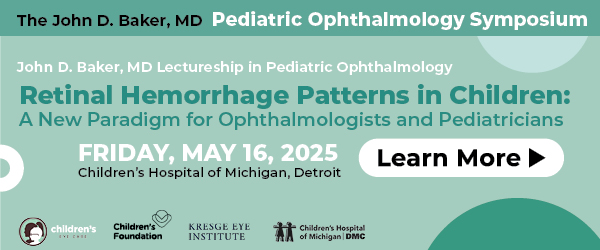
John D. Baker, MD Pediatric Ophthalmology Symposium 2027 | Baker Day Detroit
February 4, 2025
Vision Through Music®: Expanding Access to Music for Blind and Visually Impaired Children
March 26, 2025

Firework Eye Safety for Children in Michigan | Pediatric Eye Injury Prevention
May 17, 2026
The History of Pediatric Ophthalmology at Children’s Hospital of Michigan
September 30, 2026
view all articles