
Pediatric Ptosis: Droopy Eyelids in Babies & Children
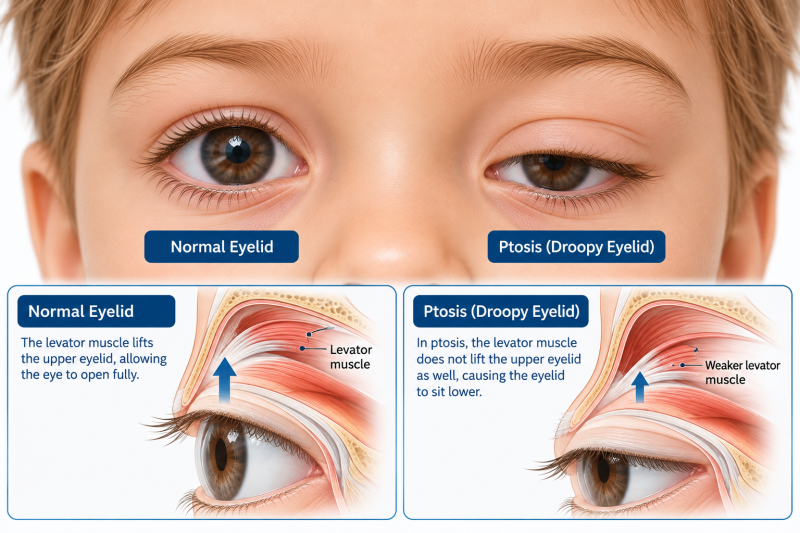
Ptosis is drooping of the upper eyelid. In children, significant ptosis can interfere with normal vision development.
A droopy upper eyelid, medically called ptosis, can be present when a baby is born or develop later in childhood.
Sometimes ptosis is primarily a cosmetic difference. In other children, however, the eyelid can interfere with normal visual development by blocking vision, causing astigmatism or encouraging the brain to favor the other eye.
That distinction is especially important in babies and young children because their visual systems are still developing.
At Children’s Eye Care, our pediatric ophthalmologists have extensive experience evaluating and treating congenital and acquired ptosis in babies, children and adolescents. We look beyond how the eyelid appears to determine whether ptosis is affecting vision, eye development, head position or eye movement—and whether observation or surgery is the better choice.
Pediatric Ptosis Specialists in Metro Detroit
Children’s Eye Care has specialized in pediatric eye disease in Metro Detroit since 1973.
Our pediatric ophthalmologists evaluate children with simple congenital ptosis as well as more complicated eyelid drooping associated with abnormal eye movements, neurologic conditions, trauma, developmental eye abnormalities and other medical conditions.
Pediatric ptosis requires more than deciding whether one eyelid looks lower than the other.
The important questions are:
Is the eyelid interfering with vision?
Is it creating astigmatism?
Has amblyopia developed?
Is the child lifting the chin to see underneath the eyelid?
How well does the eyelid muscle work?
Has the ptosis always been present, or is it new?
Is there another eye, muscle or neurologic condition causing it?
And if surgery is needed, which surgical approach is appropriate for this child’s eyelid?
Those questions guide treatment much more than appearance alone.
What Is Ptosis?
Ptosis means that the upper eyelid sits lower than it normally should.
It can affect:
- One eye
- Both eyes
- Babies and young children
- Older children and adolescents
The amount of drooping can range from barely noticeable to severe enough that the eyelid covers much of the pupil.
Some children have a stable eyelid position throughout childhood. Others may have ptosis that changes depending on fatigue, eye movement or another underlying condition.
What Causes Congenital Ptosis?
Congenital ptosis is present at birth or develops very early in life.
The most common cause is abnormal development of the levator muscle, the primary muscle responsible for lifting the upper eyelid.
In congenital ptosis, the levator may be weaker and less elastic than normal. The eyelid therefore does not lift as high as it should, and it may also move differently when the child looks up or down.
Congenital ptosis most commonly affects one eye, although both eyelids can be involved.
In many children it occurs by itself.
In others, ptosis may be associated with additional abnormalities involving the eyelid, eye movements, muscles or nerves.
Does Congenital Ptosis Get Better as a Child Grows?
Sometimes the appearance becomes less noticeable as the child’s face grows, but true congenital ptosis generally does not simply disappear because a child gets older.
The eyelid muscle itself developed differently.
For children whose ptosis is mild and not affecting vision, observation may be perfectly appropriate.
That does not mean the condition is being ignored.
It means we are watching the things that matter most: vision, prescription, eye alignment, head position and the development of amblyopia.
Can Ptosis Affect a Child’s Vision?
Yes.
This is the most important difference between evaluating ptosis in a child and evaluating an eyelid purely for appearance.
Ptosis can interfere with vision in several ways.
Ptosis Can Block Vision
If the eyelid droops far enough to cover the pupil, it can prevent a clear image from reaching the eye.
In a young child, prolonged obstruction can cause deprivation amblyopia.
Ptosis Can Cause Astigmatism
An eyelid does not necessarily need to completely cover the pupil to affect vision.
Pressure from a significantly drooping eyelid can alter the shape of the cornea and create or worsen astigmatism.
If one eye receives a blurrier image during visual development, the child can develop refractive amblyopia.
This is one of the reasons pediatric ophthalmologists evaluate the child’s prescription carefully rather than deciding the severity of ptosis from appearance alone.
Ptosis Can Lead to Amblyopia
Children with ptosis can develop amblyopia because vision is physically obstructed, because the eyelid changes the eye’s focusing error, or because another associated condition such as strabismus is present.
That means a child may have a relatively open pupil and still require close visual monitoring.
Related: Amblyopia (Lazy Eye) in Children
Why Does My Child Tilt the Head Back to See?
Children with significant ptosis sometimes adopt a chin-up head position to see underneath the drooping eyelid.
Parents may notice that the child frequently raises the chin, tips the head backward or uses the forehead muscles to lift the eyelids.
This can be an important clue that the eyelid is interfering with normal function.
A persistent abnormal head posture may also interfere with comfortable movement and daily activities.
For a young child, the question isn’t simply “Can I still see part of the pupil?”
The better question is:
What does the child have to do in order to see?
How Is Ptosis Diagnosed in Children?
A pediatric ptosis examination evaluates much more than eyelid appearance.
Our pediatric ophthalmologists consider:
- When the ptosis began
- Whether it has changed
- Whether one or both eyes are affected
- Whether the eyelid position varies during the day
- Whether double vision is present
- Whether the child uses a chin-up head position
- Vision in each eye
- The child’s refractive error
- Eye alignment
- Eye movements
- Pupil responses
- Eyelid position
- Eyelid crease and contour
- How well the levator muscle functions
- Whether the child can close the eye completely
- Other neurologic or facial findings when relevant
Old photographs can also be extremely helpful when the timing of onset is uncertain.
The goal is to determine not simply how much the eyelid droops, but why it droops and what effect it is having on the child.
How Do You Measure Ptosis in a Child?
Pediatric ophthalmologists use several measurements to understand eyelid position and function.
One of the most important is levator function—how effectively the muscle responsible for lifting the eyelid works.
We also assess the relationship between the eyelid and pupil and compare the eyelids with one another.
These measurements influence treatment because the operation that works well for a child with good levator function may not be the best operation for a child whose levator barely functions at all.
That is why pediatric ptosis surgery is not a single standardized procedure.
What Is Acquired Ptosis?
Acquired ptosis develops after a child’s eyelids previously appeared normal.
Possible causes include problems affecting the eyelid muscle, the nerves controlling the eyelid, trauma, inflammation, mechanical weight on the eyelid or other neurologic or muscular conditions.
Because congenital and acquired ptosis can have very different causes, when the drooping began matters greatly.
A baby who has had a stable droopy eyelid since birth presents a very different clinical situation from an older child whose eyelid suddenly begins drooping.
When Is a New Droopy Eyelid Concerning?
A newly drooping eyelid should be evaluated, particularly when the change is sudden or accompanied by other symptoms.
More concerning features can include:
- New double vision
- Unequal pupils
- Abnormal eye movement
- Headache
- Eye pain
- Weakness or other neurologic symptoms
- Recent significant trauma
- Rapidly changing eyelid position
These findings can indicate that the problem involves more than the eyelid itself.
A new ptosis associated with neurologic or pupil abnormalities can require prompt evaluation.
Can Ptosis Be Associated With Eye-Movement Problems?
Yes.
Some forms of ptosis occur along with abnormalities of the nerves or muscles that control eye movement.
Children’s Eye Care’s expertise in pediatric ophthalmology, strabismus and ocular motility is particularly valuable in these cases because the eyelid cannot always be evaluated independently from the movement and alignment of the eyes.
A child with ptosis may therefore undergo careful examination of:
- Eye alignment
- Eye movements
- Pupils
- Head position
- Double vision when old enough to describe it
Identifying these associations can help determine the underlying diagnosis.
Related: Strabismus
What Is Marcus Gunn Jaw-Winking Ptosis?
Some children have a congenital form of ptosis called Marcus Gunn jaw-winking syndrome.
In this condition, unusual nerve connections cause the drooping eyelid to move when the child moves the jaw.
Parents may first notice that the eyelid lifts or “winks” when the baby:
- Sucks
- Chews
- Opens the mouth
- Moves the jaw to one side
The degree of jaw-winking varies considerably.
Some children require only observation, while more significant cases may require surgical treatment.
The ophthalmologist also evaluates for associated amblyopia and strabismus because these can occur in children with jaw-winking ptosis.
Does Every Child With Ptosis Need Surgery?
No.
Many children with mild congenital ptosis can be safely observed.
Surgery is generally considered when the eyelid is causing or threatening a functional problem, or when repair is otherwise appropriate for the individual child.
Reasons to consider surgery may include:
- The eyelid blocking the visual axis
- Amblyopia or significant risk of amblyopia
- Astigmatism caused or worsened by the eyelid
- A significant chin-up head position
- Severe eyelid asymmetry
- Functional difficulty related to the eyelid
- Significant ptosis that remains as the child approaches preschool or school age
The timing is individualized.
A child whose vision is threatened may need surgery much earlier than a child whose ptosis is mild and primarily affects appearance.
Should We Wait Until My Child Is Older for Ptosis Surgery?
Sometimes waiting is appropriate.
Sometimes it isn’t.
If ptosis is mild, vision is developing normally and the child has no significant abnormal head posture, allowing the face and eyelids to mature before surgery can be reasonable.
But when ptosis is interfering with vision or threatening visual development, delaying surgery simply because the child is young can allow amblyopia to become more difficult to treat.
The decision should therefore be based on the child’s visual development and function, not simply on a preferred cosmetic age for surgery.
How Is Ptosis Surgery Done in Children?
There is not one operation used for every child.
The surgical technique depends heavily on how well the child’s levator muscle works, the severity of the ptosis and other characteristics of the eyelid.
Two broad approaches are commonly used.
Levator Surgery
When the levator muscle has enough useful function, the surgeon may tighten or shorten the levator mechanism so it lifts the eyelid more effectively.
The exact surgical technique is tailored to the child’s eyelid anatomy and degree of ptosis.
Frontalis Sling Surgery
When levator function is very poor, tightening that weak muscle may not provide enough lift.
Instead, the eyelid can be connected to the frontalis muscle in the forehead using a sling.
The child can then use the forehead muscle to help elevate the eyelid.
This is a particularly important technique for severe congenital ptosis with poor levator function.
The appropriate operation is therefore not determined simply by how low the eyelid sits.
It depends on how the eyelid works.
What Should Parents Expect After Pediatric Ptosis Surgery?
The eye and eyelid are usually swollen and bruised after surgery.
The amount and duration vary depending on the procedure.
Families receive specific instructions about postoperative medication, activity and eyelid care.
One of the unique considerations after ptosis surgery is that the eyelid may not close as completely as it did before surgery, especially immediately afterward.
The surgeon balances two competing goals:
lifting the eyelid enough to improve function while still allowing the eye to remain adequately protected.
Because children with congenital ptosis have abnormal eyelid muscle function to begin with, perfect symmetry in every direction of gaze is not always possible.
Our goal is a safe, functional eyelid position that protects vision and provides the best achievable alignment between the eyelids.
Will My Child’s Eyelids Look Exactly the Same After Surgery?
Not necessarily.
It is important for families to have realistic expectations about congenital ptosis surgery.
A congenitally abnormal levator muscle cannot be transformed into a completely normal muscle.
Surgery can significantly improve eyelid height and function, but differences may remain in:
- Eyelid height
- Eyelid contour
- Eyelid crease
- Movement of the eyelid when looking down
- Closure of the eyelids
- Symmetry between the eyes
Some children may eventually require additional surgery as they grow.
The goal is not simply photographic symmetry.
The priorities are vision, eye protection, function and the best achievable eyelid appearance.
Can Ptosis Return After Surgery?
Ptosis can sometimes recur or change as a child grows.
The tissues of a child’s face and eyelids continue developing for many years, and the underlying levator abnormality does not disappear because surgery was performed.
Some children require only one procedure.
Others may eventually benefit from another adjustment or operation.
Long-term follow-up allows the ophthalmologist to monitor both eyelid position and vision development.
Will Ptosis Surgery Fix Amblyopia?
No.
Ptosis surgery can remove or reduce an obstacle to vision, but it does not automatically reverse amblyopia that has already developed.
A child may still require:
- Glasses
- Patching
- Other amblyopia treatment
This is why visual rehabilitation and eyelid surgery need to remain connected.
Ptosis surgery improves the opportunity to see. Amblyopia treatment helps the brain learn to use that vision.
Related: Amblyopia | Patching Help for Parents
The Role of Orthoptists in Children With Ptosis
Children with ptosis often require repeated measurements of vision and eye alignment, particularly when there is concern for amblyopia or associated strabismus.
Children’s Eye Care’s orthoptists have specialized expertise in measuring vision in babies, toddlers and young children who cannot perform a traditional adult eye examination.
Working alongside our pediatric ophthalmologists, they can help monitor:
- Vision in each eye
- Development of amblyopia
- Eye alignment
- Abnormal head position
- Response to glasses or patching
- Associated eye-movement abnormalities
This is particularly valuable for children who are being observed before surgery or followed through the years after surgery.
Pediatric Ptosis Expertise at Children’s Eye Care
Children’s Eye Care has specialized in pediatric ophthalmology in Metro Detroit since 1973, caring for children with both common and complex disorders of the eyelids, eye muscles and developing visual system.
Our pediatric ophthalmologists evaluate and treat congenital ptosis, acquired ptosis, severe vision-threatening ptosis, jaw-winking ptosis and ptosis associated with other ocular or neurologic conditions.
Our expertise extends beyond eyelid surgery.
We evaluate whether the eyelid is affecting the child’s refractive error, whether amblyopia is developing, whether abnormal head posture is interfering with function, whether the eye movements or pupils suggest a broader diagnosis and which surgical approach best matches the child’s eyelid function.
When surgery is required, our pediatric ophthalmologists select the procedure based on the individual child’s anatomy, severity of ptosis and levator function rather than using one operation for every droopy eyelid.
And because Children’s Eye Care also has extensive expertise in amblyopia, strabismus, refractive development and orthoptic care, children can continue to receive the visual treatment they need before and after their eyelid procedure within the same pediatric eye-care team.
That matters because successful pediatric ptosis treatment is not simply about raising an eyelid.
It is about protecting vision while a child’s visual system is still developing.
Frequently Asked Questions About Pediatric Ptosis
What is ptosis?
Ptosis is the medical term for a drooping upper eyelid. It can affect one eye or both eyes and may be present from birth or develop later.
What causes ptosis in babies?
The most common cause of congenital ptosis is abnormal development of the levator muscle responsible for lifting the upper eyelid.
Can congenital ptosis go away on its own?
True congenital ptosis usually does not disappear completely as a child grows, although its appearance may become less noticeable as the face matures. Mild cases may never require surgery.
Can ptosis damage my child’s vision?
Yes. Significant ptosis can block vision or produce astigmatism, either of which can lead to amblyopia during childhood.
Does the eyelid have to cover the pupil to cause a vision problem?
No. Even when the pupil remains partly open, pressure from a drooping eyelid can create significant astigmatism and contribute to amblyopia.
Why does my child keep tilting the head backward?
Children with significant ptosis may adopt a chin-up position to see underneath the drooping eyelid. A persistent abnormal head position can be a reason to consider surgical treatment.
Does every child with ptosis need surgery?
No. Mild ptosis that does not affect vision or function can often be monitored.
What age should a child have ptosis surgery?
There is no single correct age. A child with vision-threatening ptosis may require surgery during infancy or early childhood, while a child with mild ptosis may safely wait until later. Timing depends on vision, eyelid function and the individual child.
How do doctors decide which ptosis surgery to perform?
One of the most important factors is how well the levator muscle works. Children with useful levator function may benefit from surgery involving that muscle, while severe ptosis with poor levator function may require a frontalis sling.
What is a frontalis sling?
A frontalis sling connects the eyelid to the forehead muscle so the child can use the forehead to help lift an eyelid when the natural levator muscle is too weak.
Will my child’s eyelids be perfectly even after surgery?
Perfect symmetry cannot always be achieved because congenital ptosis results from abnormal muscle development. Surgery is designed to improve eyelid height and function while maintaining eye protection.
Can ptosis come back after surgery?
It can. Some children’s eyelid position changes as they grow, and additional surgery may occasionally be needed.
Will surgery cure my child’s amblyopia?
No. Surgery can improve the visual pathway, but a child who already has amblyopia may still need glasses, patching or other amblyopia treatment.
What is jaw-winking ptosis?
Marcus Gunn jaw-winking is a congenital condition in which abnormal nerve connections cause a drooping eyelid to move when the child sucks, chews or moves the jaw.
Is sudden ptosis in a child an emergency?
A new drooping eyelid—especially when associated with unequal pupils, abnormal eye movements, double vision, significant headache, weakness or other neurologic symptoms—requires prompt medical evaluation.
SCHEDULE AN APPOINTMENT
Ophthalmologists
Meet our pediatric ptosis surgeons





Related Posts
More from Children's Eye Care
Hiring Patient Services Representatives & Medical Receptionists
April 29, 2025
The History of Pediatric Ophthalmology at Children’s Hospital of Michigan
September 30, 2026

Firework Eye Safety for Children in Michigan | Pediatric Eye Injury Prevention
May 17, 2026
Vision Through Music®: Expanding Access to Music for Blind and Visually Impaired Children
March 26, 2025
view all articles