
The most common vision problem in children is amblyopia, or lazy eye. Amblyopia is a decrease in the child’s vision that can happen even when there is no problem with the structure of the eye. The decrease in vision results when one or both eyes send a blurry image to the brain. The brain then learns to only see blurry with that eye, even when glasses are used. Only children can get amblyopia. If it is not treated, it can cause permanent loss of vision.
There are several different types and causes of amblyopia: Strabismic amblyopia, deprivation amblyopia, and refractive amblyopia. The end result of all forms of amblyopia is reduced vision in the affected eye(s).
One of the most important treatments of amblyopia is correcting the refractive error with consistent use of glasses and/or contact lenses. Other mainstays of amblyopia treatment are to enable as clear an image as possible by forcing the child to use the nondominant eye. This is most commonly done with patching the dominant eye to force the weak eye to get stronger. Patching should only be done if an ophthalmologist recommends it. An ophthalmologist should regularly check how the patch is affecting the child’s vision. Although it can be hard to do, patching usually works very well if started early enough and if the parents and child follow the patching instructions carefully.
If your child is being treated for amblyopia by patching, see our FAQ about Patching for more information.
Blurring the vision in the good eye with drops or with extra power in the glasses is another technique used to force the eye with amblyopia to get stronger. Ophthalmologists use this treatment instead of patching when the amblyopia is not very bad or when a child is unable to wear the patch as recommended.
Source: American Association for Pediatric Ophthalmology and Strabismus
Children’s Eye Care provides this information for general educational purposes only. It should not be construed as personal medical advice. Information published on this website is not intended to replace, supplant, or augment a consultation with an eye care professional. Children’s Eye Care disclaims any and all liability for injury or other damages that could result from use of the information obtained from this site.
Frequently Asked Questions
SCHEDULE AN APPOINTMENT







RELATED POSTS
What’s new with pediatric glaucoma
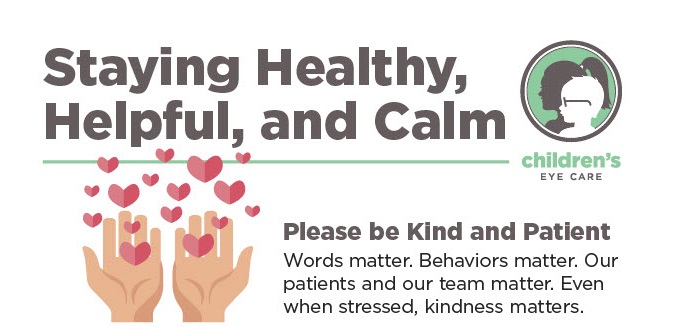
Staying Healthy, Helpful and Calm – Children’s Eye Care’s Health Policies
Please be Kind and Patient. Words matter. Behaviors matter. Our patients and our team matter. Even when stressed, kindness matters. Masks are Optional. While masks are optional for patients, guests, doctors and staff; please respect those that choose to wear one. All clinical staff and doctors will wear masks when examining premature babies. And, if any family/patient is masked when we
Feb. 24, 2023
Dr. Baker Honored with Award for Excellence
Dr. Baker was honored today with the Marshall M. Parks, MD Medal for excellence for the monumental contributions in the field of pediatric ophthalmology and strabismus. Dr. Baker has dedicated his career to fighting for patients, enhancing his field and training the next generation. He is incredibly deserving of every accolade bestowed upon him. He is our mentor, our peer
Apr. 07, 2016
Winner of the 2015 Richard G. Scobee Memorial Award
Nina Palomba, CO, COA won the 2015 Richard G. Scobee Memorial Award. This national recognition is given to the orthoptist, and training program, who received the highest written and oral scores on that year’s board certification. Ms. Palomba joined Children’s Eye Care in 2011 as an ophthalmic tech-trainee a year after completing her BS in child development at Central Michigan University.
Nov. 18, 2015
John D. Roarty, MD named Distinguished Alumni of the Year
Dr. John Roarty, pediatric ophthalmologist at Children’s Eye Care in metro Detroit and Chief of Ophthalmology at Children’s Hospital of Michigan, was named Distinguished Alumni of the Year by Henry Ford Health System’s Department of Ophthalmology. Dr. Roarty completed a pediatric residency at University of California-Davis for pediatrics from 1983-1986. After his pediatric residency, he completed an Ocular Pathology fellowship at at the
Oct. 10, 2015
view all articles