
What is Cranial Nerve VI Palsy?
Sixth cranial nerve palsy is weakness of the nerve that innervates the lateral rectus muscle. The lateral rectus muscle rotates the eye away from the nose and when the lateral rectus muscle is weak, the eye crosses inward toward the nose (esotropia). The esotropia is larger when looking at a distant target and looking to same side as the affected lateral rectus muscle.
What causes Cranial Nerve VI Palsy?
The most common causes of sixth cranial nerve palsy are stroke, trauma, viral illness, brain tumor, inflammation, infection, migraine headache and elevated pressure inside the brain. The condition can be present at birth; however, the most common cause in children is trauma. In older persons, a small stroke is the most common cause. Sometimes the cause of the palsy is never determined despite extensive investigation.
The sixth cranial nerve has a long course from the brainstem to the lateral rectus muscle and depending on the location of the abnormality, other neurologic structures may be involved. Hearing loss, facial weakness, decreased facial sensation, droopy eyelid and/or abnormal eye movement can be associated, depending on the location of the lesion.
Does Sixth Cranial Nerve Palsy improve with time?
It is possible for palsies to resolve with time, and the amount of resolution primarily depends on the underlying cause. Palsy caused by viral illness generally resolves completely; whereas palsy caused by trauma is typically associated with incomplete resolution. Maximum improvement usually occurs during the first six months after onset.
What are the symptoms of Sixth Nerve Palsy?
Double vision (2 images seen side by side) is the most common symptom. If one eye is involved, the separation between the 2 images is greatest on gaze in the direction of the affected eye (for example, gaze to the left in a left sixth nerve palsy). There is usually less double vision on near fixation than on distance fixation. Children typically do not experience persistent double vision, but are prone to develop amblyopia depending on the severity and duration of the sixth nerve palsy.
How is the double vision associated with Sixth Nerve Palsy alleviated?
Prism spectacles can realign the images and allow single binocular vision in straight ahead gaze. Because the degree of the misalignment varies in different gaze positions, prism correction does not eliminate double vision in every gaze position. The power of prism can be reduced as the palsy improves. Patching one eye eliminates diplopia, however, this treatment must be carefully monitored in children to avoid the development of amblyopia.
Can Sixth Nerve Palsy be fixed?
After observation for improvement (usually six months), strabismus surgery can be performed to improve eye alignment if prism correction is not satisfactory. Botulinum toxin alone or in conjunction with surgery is occasionally utilized to temporarily weaken the opposing inward pulling medial rectus muscle.
Frequently Asked Questions
SCHEDULE AN APPOINTMENT















RELATED POSTS
What’s new with pediatric glaucoma

Staying Healthy, Helpful and Calm – Children’s Eye Care’s Health Policies
Please be Kind and Patient. Words matter. Behaviors matter. Our patients and our team matter. Even when stressed, kindness matters. Masks are Optional. While masks are optional for patients, guests, doctors and staff; please respect those that choose to wear one. All clinical staff and doctors will wear masks when examining premature babies. And, if any family/patient is masked when we
Feb. 24, 2023

New Orthoptist Joins Children’s Eye Care
Introducing our newest board-certified orthoptist. For the past two years, we’ve had the pleasure of having Lauren as our orthoptic student. You’ve likely seen her working with our orthoptists and doctors in Clinton Twp, Dearborn, Detroit and West Bloomfield. Maybe you even caught a glimpse of her pouring over neuro-ophthalmology chapters. No matter what she was doing, it was with
Sep. 21, 2019
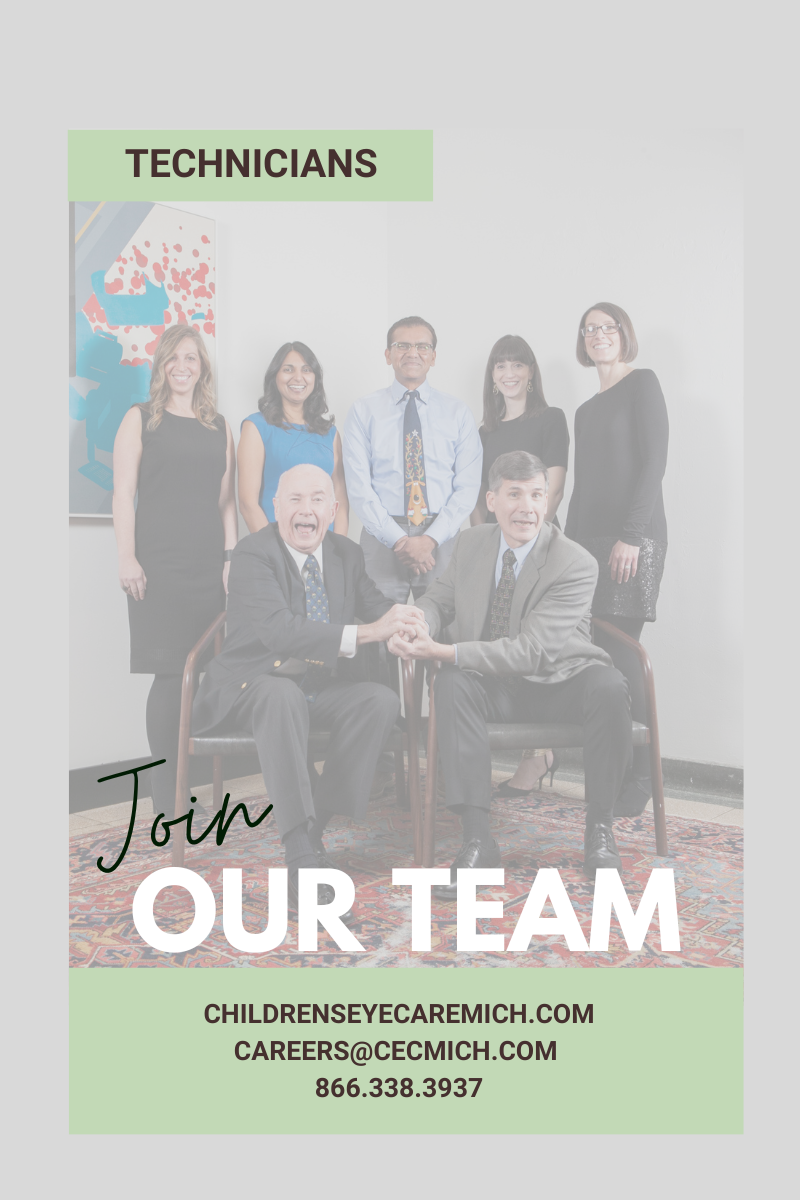
Hiring Pediatric Ophthalmic Technicians – Metro Detroit
Pediatric Ophthalmic Technician – Join a Leading Team in Pediatric Eye Care! Are you ready to launch or elevate your career in ophthalmic technology? We’re looking for passionate, detail-oriented, and motivated individuals to join our team. Why This Role? We are one of the nation’s premier pediatric ophthalmology practices, offering a unique blend of private practice, teaching and academic medicine. We are seeking ophthalmic technicians.
Apr. 12, 2025

Optical needs, in metro Detroit, during the COVID-19 Pandemic
April 14, 2020 Our opticals are closed, and we are not allowing our opticians to have face-to-face time with any patients. You can visit our Optical page for FAQ. Also, Barb and Kevin will be working remotely a couple of hours once or twice weekly. You can call our offices to leave a message for them or email us at info@cecmich.com with
Apr. 14, 2020
view all articles