
What is a Fourth Nerve Palsy?
The fourth cranial nerve innervates the superior oblique muscle, so weakness of the nerve is also known as superior oblique palsy. Weakness of the superior oblique muscle causes a combination of vertical, horizontal and torsional misalignment of the eyes. The vertical misalignment is typically the most noticeable feature. Palsy refers to a complete weakness of a muscle while a paresis is a partial weakness. This condition is usually unilateral (one eye) but can be bilateral (both eyes).
Does Superior Oblique Palsy cause double vision (Diplopia)?
Superior oblique palsy may cause double vision because of misalignment of the eyes (the brain perceives an image from two different directions). The double vision may be vertical (one image on top of the other), diagonal (vertically and horizontally separated) and less often torsional (rotated or twisted). The torsional phenomenon occurs more frequently with acquired cases of superior oblique palsy. Congenital (present at birth) superior oblique palsy usually does not cause double vision in childhood, and a head tilt may be the only symptom.
Why is the head tilted with Superior Oblique Palsy?
Head tilt and/or turn is common with superior oblique palsy. The abnormal head position allows better alignment of the eyes, sometimes aiding in relief of diplopia. A child with a head tilt should be evaluated by an ophthalmologist for superior oblique palsy and other possible eye problems.
What causes Superior Oblique Palsy?
Superior oblique palsy can be congenital or acquired. Other congenital anomalies may be associated with superior oblique palsy (e.g. a misshaped skull – craniosynostosis). A common cause of acquired superior oblique palsy is head trauma, including relatively minor trauma. A concussion or whiplash injury from a motor vehicle accident may be sufficient enough to cause the problem. Rare causes of superior oblique palsy are stroke, tumor and aneurysm.
How is Superior Oblique Palsy treated?
In cases of acquired superior oblique palsy it is important to identify and treat the underlying cause first. Once the cause of an acquired superior oblique palsy has been treated, the ophthalmologist will usually wait 6 months for possible spontaneous resolution of the palsy. During that period, diplopia can be managed with prism glasses. Prisms merge two images into one but do not strengthen the eye muscles. If prism is not effective, patching or covering one eye can alleviate the double vision. If the palsy does not recover over this 6-month period and if prisms are not able to adequately control the diplopia, surgery may be indicated.
The treatment of choice for congenital superior oblique palsy and for an unresolved (after 6 months) acquired palsy is typically eye muscle surgery. Surgery usually minimizes double vision, reduces the unsightly upward drift of an eye, and corrects a compensatory head tilt. Surgery is performed on one or both eyes depending on the extent of the eye misalignment, the change of the misalignment in different directions of gaze, the amount of head tilt, and the amount of torsion.
Frequently Asked Questions
SCHEDULE AN APPOINTMENT












RELATED POSTS
What’s new with pediatric glaucoma

Children’s Eye Care Recognized as Quickest New Research Site Start-up
Susie (our research coordinator), Dr Bohra and Dr Gianfermi representing Children’s Eye Care, and accepting recognition for fastest new research clinic site start-up, at the Pediatric Eye Disease Investigator Group meeting.
Feb. 13, 2016
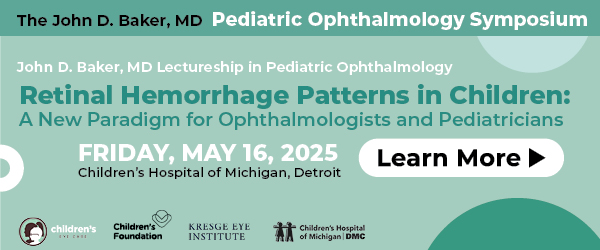
John D. Baker, MD Pediatric Ophthalmology Symposium 2025 | Baker Day Detroit
The John D. Baker, MD Pediatric Ophthalmology Symposium (Baker Day) Date: Friday, May 16, 2025. Lecture: 8:00 – 9:30 am Case Presentations: 10:00 am – 4:00 pm Location: Children’s Hospital of Michigan, 3901 Beaubien Blvd, Detroit, MI For nearly four decades, the John D. Baker, MD Pediatric Ophthalmology Symposium, affectionately known as “Baker Day,” has brought together pediatric ophthalmologists, orthoptists,
Feb. 04, 2025
Dr. Baker Honored with Award for Excellence
Dr. Baker was honored today with the Marshall M. Parks, MD Medal for excellence for the monumental contributions in the field of pediatric ophthalmology and strabismus. Dr. Baker has dedicated his career to fighting for patients, enhancing his field and training the next generation. He is incredibly deserving of every accolade bestowed upon him. He is our mentor, our peer
Apr. 07, 2016

New Orthoptist Joins Children’s Eye Care
Introducing our newest board-certified orthoptist. For the past two years, we’ve had the pleasure of having Lauren as our orthoptic student. You’ve likely seen her working with our orthoptists and doctors in Clinton Twp, Dearborn, Detroit and West Bloomfield. Maybe you even caught a glimpse of her pouring over neuro-ophthalmology chapters. No matter what she was doing, it was with
Sep. 21, 2019
view all articles